
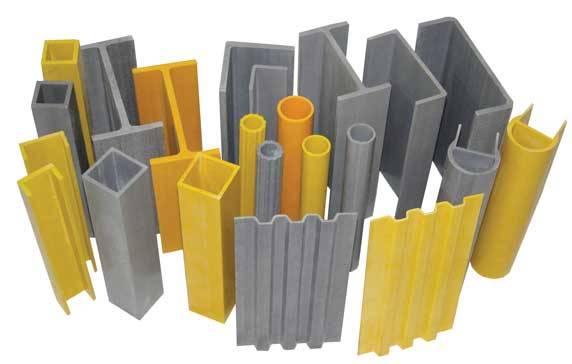
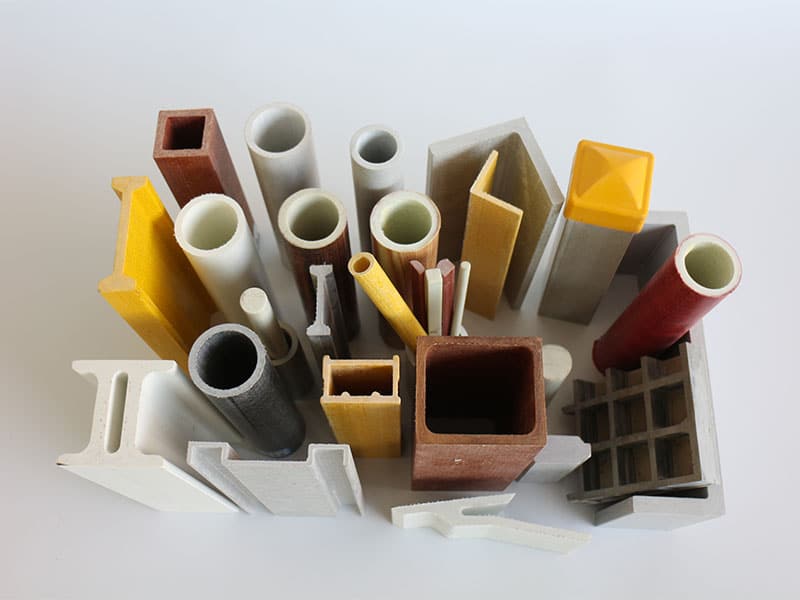
Pultrusion is a continuous process for manufacture of fibre-reinforced plastics with constant cross-section. The term is a portmanteau word, combining “pull” and “extrusion“. As opposed to extrusion, which pushes the material, pultrusion pulls the material.
A very early pultrusions type patent was filed by J.H. Watson in 1944. This was followed by M.J. Meek’s filing of 1950. The first commercial pultrusions were provided by Glastic Company of Cleveland, Ohio under the patent filed in 1952 by Rodger B. White. The patent issued to W. B. Goldsworthy in 1959 helped initiate the promotion and knowledge spread within the industry. W. Brandt Goldsworthy is widely regarded as the inventor of pultrusion.
In the standard pultrusion process the reinforcement materials like fibers or woven or braided strands are impregnated with resin, possibly followed by a separate preforming system, and pulled through a heated stationary die where the resin undergoes polymerization. The impregnation is either done by pulling the reinforcement through a bath or by injecting the resin into an injection chamber which typically is connected to the die. Many resin types may be used in pultrusion including polyester, polyurethane, vinylester and epoxy. Resin provides the resistance to the environment, (i.e., the corrosion resistance, the UV resistance, the impact resistance, etc.) and the glass provides strength, in addition to safety from fire.
Pultrusion technology of manufacturing of fiber composites with polymer matrix appears to be energy-efficient and resource-saving.
Economic and environmental factors favor use of a thermoplastic matrix but due to the high viscosity of melts it is difficult to achieve high productivity and high quality of fiberfills impregnation with this type of matrix.
Products manufactured under this technology are widely used in the following industries:

Al Jazeera Fiber UAE is an established endeavor in the field of Composites Industry in UAE. The company is well known in the Design….